Sacred Mirrors
What does it really mean to love ourselves

In a world of projection, expectation and social norms, what does it really mean to love oneself?
The Soul Gardener

What if we not here to fix or control? What if we were just tending our own garden?
Vessels of Remembrance
Lessons in holding space

A reflection on creating space for our own inner knowing.
Lessons in holding space
Lessons in holding space
Lessons in holding space

What does it mean to truly hold space—for another without carrying them, and for ourselves without closing our hearts?
A reflection on vulnerability, boundaries, and the sacred vessel we create when we gather.
The Seeker and the Sage
Lessons in holding space
The Seeker and the Sage

A journey into the field of possibility and the wisdom already within.
Reciprocal Gratitude
Lessons in holding space
The Seeker and the Sage

Moving from cost and consumption into gifting, receiving and reciprocity.

Vessels
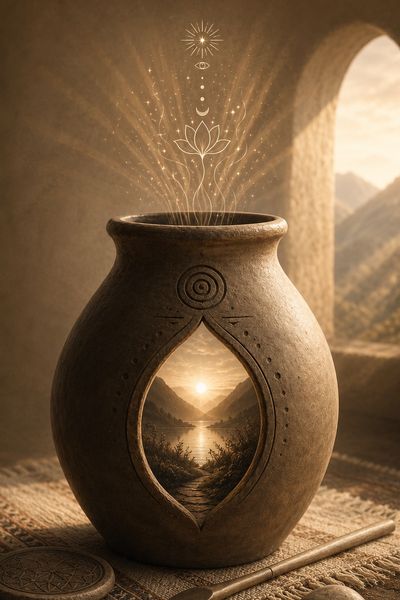
The Vessel of Remembrance
I am not here to teach you who you are.
I am here to create the conditions in which you remember.
Every story…
Every meditation…
Every workshop…
Every piece of clay…
Every Sacred Mirror…
Is simply a vessel.
A vessel does not contain truth.
It creates space for truth to reveal itself.
Just as a clay vessel holds water without becoming the water, these offerings simply hold space for your own wisdom to emerge.
I cannot give you your truth.
I cannot heal you.
I cannot awaken you.
Only you can do that.
What I can offer is a place where the noise becomes quiet enough…
The stories become light enough…
The heart becomes open enough…
That remembrance naturally arises.
I don’t want followers.
I don’t want believers.
I don’t want disciples.
I want people to leave more deeply connected to themselves than they were when they arrived.
If they remember something ancient…
Something true…
Something they always knew but had forgotten…
Then the vessel has served its purpose.
That is the work.
Not teaching.
Not convincing.
Not changing anyone.
Simply creating vessels for remembrance.
Reciprocal Gratitude
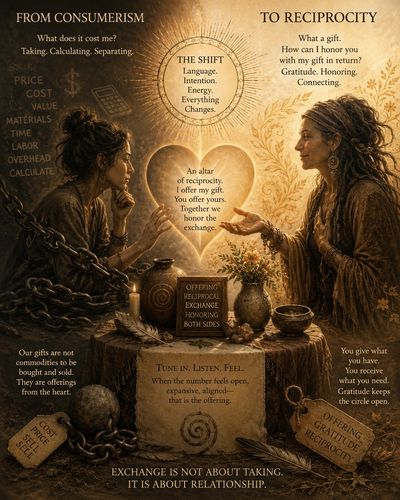
Converting Consumerism into Reciprocity
We have become so accustomed to thinking about exchange through the language of consumerism.
We ask: What does it cost?
What is the price?
How much do I have to give to receive this?
But even the word cost carries a subtle message. It implies something is being taken from us. Something is leaving. Something is lost.
If we pause and truly tune in, we can feel this in the body—the contraction, the pull, the resistance. The energetic message underneath the word “cost” is separation.
But what happens when we shift the perspective?
What if instead of saying:
“What does this cost me?”
we said:
“What a gift. How can I offer a gift in reciprocity? How can I honor what you have shared with me?”
Feel the difference.
The language changes. The energy changes. The body opens.
Gratitude creates receptivity.
When we recognize exchange as a relationship of honoring rather than a transaction of taking and giving, we deepen our ability to receive. We create an opening where the gift can actually be fully received.
And yet, there is another side to this conversation: the side of offering.
Many of us have learned to assign value through price. We put a number on something and that number becomes a measurement of worth.
But this creates another contraction.
When we don’t fully recognize our own value, we struggle to ask to be honored fully. We may minimize our gifts, overgive, or feel uncomfortable receiving in return.
So what if our gifts are not commodities?
What if they are offerings?
Our creations, our teachings, our time, our energy, our skills—these are not simply things to be bought and sold. They are gifts offered into the world with an openness to appropriate reciprocity.
For many of us who have navigated the business world, this is a profound shift.
We have been trained to calculate:
Materials.
Time.
Equipment.
Overhead.
Labor.
All the measurable things.
Then we use those calculations to arrive at a “price.”
But how exhausting is that?
Because we are trying to measure something that is often immeasurable.
A creation carries intention. It carries presence. It carries the energy of the person who brought it into being.
An offering expands where a price constricts.
So how do we integrate this into the practical world we live in?
Money is still the primary form of exchange in our society. Reciprocal exchange, as a conscious practice, is still unfamiliar to many.
Some have moved toward donation-based models, but even that can feel incomplete.
Donation can sometimes imply rescuing, charity, or giving without true exchange. It can unintentionally create an imbalance where one person gives and another receives, rather than honoring both sides of the relationship.
What if we created an altar of reciprocity?
A space—literal or symbolic—where exchange is approached with intention.
A table set with the understanding:
“I offer my gift. You offer yours. Together we honor the exchange.”
That offering may include money, partially or fully. But the foundation shifts.
The question is no longer:
“What can I sell this for?”
The question becomes:
“What am I offering, and what is an honoring reciprocity for this exchange?”
This works beautifully for things like yoga, workshops, and experiences.
But what about those of us who create physical things?
Artists, makers, craftspeople—we still live in a world where objects are placed in stores, displayed at shows, and assigned dollar amounts.
This is where it becomes sticky.
For years, I found myself creating from my business mind:
“What will sell?”
“What will people like?”
“What should I make that people will buy?”
And slowly, the joy disappeared.
I was no longer creating from connection. I was creating from calculation.
And the irony was that much of what I created from that mindset didn’t sell anyway.
The burden of trying to predict what others wanted took me away from the very thing that made my work meaningful.
So I shifted.
I returned to creating from my heart.
I asked:
“What brings me joy?”
“What wants to come through me?”
I stopped trying to make something that would appeal to everyone and started making what felt alive.
Then I offered those creations through stores.
Shows often felt exhausting because I felt like I had to become the performance—the salesperson, the personality, the song and dance behind the object.
That never felt aligned.
So I stepped away from that.
And something beautiful happened.
The pieces began finding the people they belonged with.
The creations spoke for themselves.
People were happy to exchange their money for something that brought them joy because the piece itself was created from joy.
The energy of the creation carried the intention of the maker.
Now, when I assign a dollar amount to a piece, I no longer try to rationally calculate every invisible element that went into it.
How do you measure inspiration?
How do you measure years of experience?
How do you measure the moment when something simply arrives through you?
Instead, I listen.
I feel into the number.
I say an amount, and I notice my body.
When it feels open, expansive, and aligned—that is the offering.
Perhaps this is where we begin to bridge the worlds.
For many people, money is still the language they understand. A dollar amount gives the mind something tangible to hold.
So perhaps we don’t have to reject that language completely.
Perhaps we can transform it.
Instead of:
Price: $75
we might say:
Offering: $75
or
Reciprocal Exchange: $75
The number remains, but the intention changes.
The exchange becomes conscious.
The offering becomes honored.
And slowly, perhaps we remember that exchange was never meant to be about taking.
It was always meant to be about relationship.
The Seeker and the Sage
The Seeker and the Sage
There is an old story about a seeker who longed for peace.
Believing wisdom lived high above the world, he climbed the side of a mountain. After a long journey, he came upon an old sage.
The sage carried an enormous burlap sack over one shoulder. It looked impossibly heavy.
The seeker bowed and asked,
“Great Sage, how do I find peace? How do I become enlightened?”
Without saying a word, the sage slipped the sack from his shoulder and placed it gently on the ground.
The seeker smiled.
“I understand,” he said. “Put down my burdens.”
The sage nodded.
“But…” the seeker continued, “I still have a life to live. I have responsibilities. I have work to do. When I return to the world, how do I keep my burdens from climbing back onto my shoulders?”
The sage opened the sack.
Out spilled hundreds of scrolls.
Each one held a story.
Stories of fear.
Stories of failure.
Stories of who he believed himself to be.
Stories of who he believed others expected him to be.
The seeker watched in wonder.
“I see,” he whispered. “Our burdens are the stories we carry.”
The sage smiled.
“Yes.”
The seeker felt a wave of relief, but after a moment he asked,
“Even if I let go of my stories… there will still be work to do. There will still be choices to make. I must still live in the physical world. What then?”
The sage simply turned and began walking away, leaving the scrolls scattered across the mountainside.
Confused, the seeker looked up.
Where the heavy sack had once hung, countless possibilities shimmered around the sage like heat rising from the earth.
They drifted effortlessly—appearing, disappearing, changing shape.
The seeker realized something remarkable.
The sage carried nothing.
Yet he lacked nothing.
Every possibility was available to him, but none of it weighed him down.
When the moment called for action, he simply reached into the field of possibility, chose what was needed, and let it go again when the moment had passed.
He carried no burden because he carried no story.
Only presence.
Only trust.
Only the wisdom to meet each moment as it arrived.
And the seeker understood.
Enlightenment is not the absence of responsibility.
It is the absence of attachment.
When we stop carrying the stories of yesterday and the fears of tomorrow, life itself becomes lighter.
Our responsibilities remain.
But they are no longer burdens.
They become offerings—chosen freely, carried only for the moment they are needed, and then set down once again.


Lessons in Holding Space
Lessons in Holding Space
Lessons in Holding Space
I learned something about holding space recently.
Not from doing it well.
From experiencing what it feels like when space no longer feels like it is being held for you.
I was at a drum circle with around fifty people. I have attended this circle before, but I have never completely let down my guard there. I can be vulnerable in a smaller circle of women I trust, but in this larger group, some part of me has always kept my vulnerable self safely tucked away.
This time, I decided to change that.
I wanted to bring more of my authentic self into the circle.
At the beginning, we passed the talking stick. Each person shared their name, their medicine name, and what they were bringing into the circle.
Normally, I would have offered just a few words.
But the friends beside me shared more deeply, and listening to them gave me courage to do the same.
When the talking stick reached me, I was nervous. I rambled a little. And then I began talking about the Vessels workshop I am creating and the shift happening within me around teaching—not the workshop itself so much as what it represents in my life.
And suddenly I was stopped.
The facilitator interrupted me and told me there would be time for “that” at the end.
She was referring to the time when people could announce workshops, events, and other offerings.
But I wasn’t trying to sell my workshop.
I was trying to share myself.
And I was mortified.
I passed the talking stick and immediately began crying.
It was astonishing how quickly one moment opened an entire lifetime of wounds.
Children are to be seen and not heard.
My voice doesn’t matter.
Other people get to speak, but somehow I don’t.
Women’s voices matter less.
I am unimportant.
I am too much.
Be quiet.
All those old stories came rushing to the surface.
And for a while, I went completely into the Victim.
I felt attacked.
I felt disregarded.
I felt angry.
I even found myself judging the person who had stopped me. How could someone speaking about love and light not recognize what had just happened?
And then another awareness arrived:
I get to choose what happens next.
I could stay inside the story that someone had done something to me.
Or I could recognize that perhaps this had happened in a healing space because something in me was ready to be seen.
Maybe this wasn’t punishment.
Maybe it was medicine.
I began returning to the room.
Then, after the talking stick had traveled around the entire circle, the facilitator came over, leaned down and whispered that she was sorry, but there would be time for “that” at the end.
And suddenly I felt exposed all over again.
Now I imagined everyone feeling sorry for me.
That almost felt worse.
I didn’t want pity.
I am not a victim.
Yet there I was crying again.
Thankfully, the drums began.
And once again I had a choice.
I could blame.
I could rage.
I could replay what happened.
Or I could ask:
What is here for me?
So I asked Spirit to fill me.
Transmute this.
Shift my perception.
Show me what I am meant to understand.
And an answer began to emerge.
In the drum circle I help facilitate, we have been wrestling with this exact question:
How much do we control the container?
What happens when someone talks without the talking stick?
What happens when someone speaks longer than expected?
When do we intervene?
When do we enforce the structure?
And when do we simply listen?
There have been several moments when the “rules” might have suggested stopping someone, yet energetically I felt:
Let it go.
And afterward, something that person said turned out to be exactly what someone else needed to hear.
Sometimes we simply need to listen.
And now here I was, experiencing what it felt like to be stopped instead of heard.
I had received my answer.
I never want to do that to someone else.
Structure matters.
The vessel matters.
Boundaries matter.
But so does presence.
Holding space requires enough awareness to recognize when the structure serves the people inside it—and when the people inside it need something different from the structure.
So I allowed myself to feel everything.
I cried for every version of myself who had felt unheard, disregarded, dismissed, or silenced.
I placed my hands and feet against the floor and pushed the pain and anger into the Earth, asking for it to be transmuted.
Around me, the drums continued.
The vibration moved through every cell of my body.
Shaking.
Loosening.
Releasing.
I stayed there until I felt the tension begin leaving my body.
Then I sat upright.
Fill me with Love.
I reminded myself:
I get to choose.
I am not the trauma of my previous stories.
I can write new stories.
I am not a victim.
Only after I felt that shift did I move onto the carpet where people could lie down and be drummed over.
I hadn’t wanted to go there while I was still inside the victim story.
I wanted to bring the new story with me.
As the drums surrounded my body, something unexpected happened.
My voice came.
First a growl.
Then a low tone.
Then something deeper and more primal until finally it became a guttural scream.
Anger leaving.
Voice returning.
My entire body buzzed.
And I felt strong.
When the drumming ended, we returned to our seats. We sang together for a while, and then it was time to close the circle.
The facilitator again brought attention to what had happened by saying that since she had cut me off earlier, I could begin.
I could feel that old discomfort rising again.
This time, though, I simply said:
“I am not a victim.”
I shared some of what had happened inside me—the wound that had been triggered and my choice to work with it differently.
And something else happened that fascinated me.
I didn’t return to promoting my workshop.
When someone later asked about it, because she remembered that was what I had been talking about when I was interrupted, I simply told her that if she was interested she could find me afterward.
And she did.
Still, I noticed something.
I had allowed the experience to take some of the energy out of my offering.
There is another lesson there.
Maybe reclaiming my voice doesn’t only mean being willing to speak.
Maybe it also means not abandoning what I was speaking about simply because someone else misunderstood it.
There was another beautiful piece of medicine that day.
Spirit had placed two extraordinary souls beside me.
Neither tried to fix me.
Neither told me what I should feel.
Neither rushed to rescue me.
I didn’t feel pity from them.
I didn’t feel judgment.
They simply stayed.
Present.
Witnessing.
Loving.
They held space.
And perhaps that was the clearest teaching of the entire circle.
Holding space is not rescuing someone from their experience.
It is not controlling their experience.
It is not deciding what their experience should look like.
It is creating a strong enough vessel that another person can safely encounter themselves within it.
That doesn’t mean there are no boundaries. A vessel without boundaries cannot hold anything.
But boundaries and control are not the same thing.
Structure and rigidity are not the same thing.
And presence sometimes asks us to listen beyond the rules.
I also came away recognizing that teachers can teach us in more than one way.
I have learned things from this facilitator that I want to bring into the drum circle in my own community.
And I have learned things I do not want to bring.
Both are teachings.
I still notice judgment arising in me around spirituality and money—particularly when spiritual leadership begins to feel transactional or centered around the teacher. That reaction is mine to examine too.
Perhaps I don’t need to decide who she is.
I only need to decide who I am going to be.
I know what kind of space I want to create.
I don’t want people dependent upon me.
I don’t want people looking toward me for their answers.
I want to create a vessel strong enough for people to discover their own.
And if someone becomes vulnerable inside that vessel, I hope I remember this day.
Before correcting.
Before controlling.
Before assuming.
Listen.
Be present.
Read the energy.
Hold the vessel.
And trust that sometimes what appears to be an interruption of the circle may actually be exactly what the circle needs.
But the teaching wasn’t quite finished.
Immediately after this experience, I came upon a Great Horned Owl who had been struck on the road.
After everything that had just moved through me, I couldn’t experience this encounter as ordinary.
I brought the owl home and laid its body to rest beneath my guardian tree, returning it to the Earth with honor.
And there it was again:
Earth.
The same Earth I had pressed my hands and feet against as I released the old pain.
The same Earth I had asked to receive and transmute what I was ready to let go.
Now receiving the body of this magnificent being.
I don’t need to decide exactly what the owl meant.
I don’t need to turn it into a message or make Spirit speak words that weren’t spoken.
It was enough to notice the synchronicity.
Something old in me had been brought into the light that day.
I had felt it.
I had cried it.
I had raged it.
I had given it to the Earth.
And through the drums, I had found my voice beneath it.
Then an owl came into my path—a being I associate with seeing into darkness, with discernment, with the mysteries we cannot always explain.
Its life had ended.
Its body returned to Earth.
But the encounter itself became part of the medicine.
Perhaps that is what transformation actually asks of us.
Not to destroy our old stories.
Not to deny them.
Not to pretend they never wounded us.
But to honor what they have carried, take the wisdom from them, and allow what is finished to return to the Earth.
Death.
Release.
Transmutation.
Remembrance.
I entered that circle believing someone had taken my voice away.
But no one can take something from me that is inherently mine.
My voice was still there.
Under the hurt.
Under the anger.
Under the old stories.
Waiting.
And when it returned, it didn’t whisper.
It roared.
And then I carried what was finished home…
and laid it beneath the tree.
Presence is a Vessel of Love
Presence is a Vessel of Love
Holding Space
We live in a culture that seems to believe there is always something wrong.
Something to fix.
Something to heal.
Something to improve.
Something that needs an answer.
And somewhere along the way, we have forgotten the power of simply being present.
Women have often been taught to hold more than what is theirs—to nurture, soothe, anticipate, carry and care for the needs of everyone around them.
Men have often been taught that love means protecting, providing and solving—to see a problem and find a way to fix it.
Perhaps neither is wrong.
Perhaps what has been lost is the balance within each of us.
The ability to nurture without carrying.
To protect without controlling.
To care without rescuing.
To love without believing we know what another person needs.
We have become so accustomed to looking outside ourselves for answers that even our attempts to help one another can reinforce the belief that the answer exists somewhere out there.
Someone else knows.
Someone else can fix it.
Someone else can make this feeling go away.
But what if one of the greatest gifts we can give another person is the space to discover that they are capable of meeting themselves?
Recently, I experienced this in a way I could feel rather than simply understand.
I was sitting in circle, moving through something painful. There were people on either side of me, and neither tried to change what I was experiencing.
They didn’t offer advice.
They didn’t tell me how to see it differently.
They didn’t try to make the pain disappear.
They simply stayed.
Present.
Supportive.
Loving.
And within the space they held, I was able to meet myself.
I could witness what was happening inside me. I could feel the pain and recognize the places being triggered. And because no one was trying to move me out of the experience, I was able to move through it myself.
The pain became information.
The trigger became a mirror.
And eventually, my perspective shifted—not because someone gave me a better one, but because I was given enough space to find my own.
I am beginning to experience this at home, too.
My husband has often responded to what I’m going through by trying to help. Offering solutions. Suggesting what I might do. Trying to make things better.
And lately, something has changed.
He listens.
He lets me talk through whatever I am thinking, feeling or processing without needing to find the answer for me.
He is simply there.
And when I reach the other side of whatever needed to move through me, something remarkable happens.
Instead of feeling the familiar irritation of being fixed, I feel love.
Because I haven’t been managed.
I’ve been witnessed.
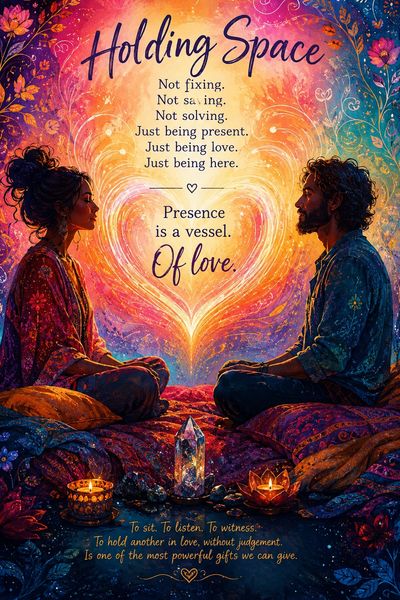
Maybe this is what holding space truly is.
Not taking responsibility for another person’s journey.
Not standing outside the vessel reaching in, rearranging things because we believe we know how they should be.
But sitting beside it.
Present enough to witness.
Loving enough not to judge.
Grounded enough not to rescue.
Trusting enough to allow another person to find their own way.
There are certainly moments when help is needed. Moments when we ask for advice, guidance, protection or another pair of hands.
But perhaps we don’t have to begin there.
Perhaps we can begin with presence.
Do you need something from me, or do you simply need me to be here?
And perhaps we can learn to offer ourselves the same gift.
To sit with our own discomfort without immediately trying to fix it.
To listen before judging.
To feel before escaping.
To become both the one who experiences and the one who lovingly witnesses.
Maybe that is part of returning to balance.
We stop carrying what belongs to another.
We stop handing away what belongs to us.
And we meet one another in the space between.
Not fixer and broken.
Not rescuer and rescued.
Simply two human beings, each whole, each capable, sitting together in love.
Presence is a vessel.
A vessel of love.
Presence is a Vessel of Love
Self Love
Coming Home to Myself
I woke this morning with a question:
If it were entirely up to me to give myself the love I need—the love I crave, the love I have spent so much of my life looking outside myself for—what would that actually look like?
Interestingly, the answer wasn’t as simple as I expected.
It wasn’t really about comfort, although comfort can certainly be part of loving ourselves. It wasn’t about buying myself something, taking a day off, soaking in a bath, or doing any of the things we commonly call “self-care.”
It wasn’t really about anything physical.
It was about presence.
What if loving myself means being fully present with myself?
Listening to my body. Listening to my emotions. Listening to my mind.
Not judging what I find. Not immediately trying to change it, understand it, heal it, improve it, or make it go away.
Just becoming curious about what is here.
What am I feeling right now?
What is my body telling me?
What is asking to be heard?
And then staying.
Holding space for myself in exactly the way I would want someone who truly loved me to hold space for me.
Maybe that’s what it means to feel held.
Maybe sometimes what I hear will ask me to change something, do something, speak something, set a boundary, rest, move, create, or walk away.
And maybe sometimes there will be absolutely nothing to do.
The point isn’t finding it.
The point is that I am here to listen.
That realization has me questioning something much larger.
We spend so much of our lives looking outside ourselves for what we believe we are lacking. We want someone to love us, accept us, understand us, reassure us, choose us, hear us.
And yes, another person can love us deeply. They can hold space for us. They can offer compassion and acceptance.
But can we ever completely receive that love if we cannot offer the same presence to ourselves?
Our world seems deeply conditioned around external acceptance. We learn very early what is expected of us—how to behave, how to be agreeable, how to make other people comfortable, what parts of ourselves are acceptable and which ones should probably remain hidden.
Eventually, we don’t need anyone else policing those expectations.
We do it ourselves.
We begin performing for our own acceptance.
I’ll accept myself when I’m calmer.
I’ll love myself when I’ve healed this.
I’ll feel good about myself when I’m more productive, more patient, more successful, more spiritual, less angry, less messy…
But isn’t that the very thing we’re longing to escape?
At the deepest level, don’t we simply want to be loved as our authentic selves—messy, imperfect and still learning—without having to perform for that love?
And lately I’m even questioning many of the behavioral expectations we’ve accepted as inherently “good.”
How often are niceties actually little lies?
How often do we say what is expected because the truth might make someone uncomfortable?
How often do we smile when we don’t feel like smiling, say yes when something inside us is saying no, avoid an issue because addressing it might create tension, or soften our truth until it barely resembles what we’re actually experiencing?
We call it being nice.
But sometimes what we’re really doing is abandoning ourselves to maintain someone else’s comfort.
And eventually we begin lying to ourselves too.
Something inside says, This doesn’t feel right.
And we answer, You’re overreacting.
Something says, I don’t want this.
We answer, Don’t be selfish.
Something says, I’m angry.
We answer, You shouldn’t feel that way.
Something says, No.
And we say yes.
Is that love?
I’m beginning to think love may be much simpler—and much more demanding—than that.
Love may be the willingness to remain present with what is true.
That doesn’t mean every thought I have is true. It doesn’t mean every reaction needs to become an action. And it certainly doesn’t mean throwing every feeling at another person in the name of “authenticity.”
It means nothing within me has to hide in order to be loved by me.
I can notice anger without judging it.
I can notice fear without fixing it.
I can notice resistance and become curious about it.
I can discover that I was wrong and still remain beside myself.
I can recognize something I need to change without making who I am wrong.
I can listen before deciding what any of it means.
And perhaps from that place, honesty becomes more loving too.
Sometimes love may be gentle.
Sometimes love may say no.
Sometimes love may disappoint someone.
Sometimes love may require an uncomfortable conversation.
Sometimes love may mean allowing another person to carry what belongs to them instead of rescuing them from it.
And sometimes love may simply sit quietly and listen.
Maybe unconditional love isn’t the absence of boundaries, disagreement, mistakes, anger or discomfort.
Maybe unconditional love means:
I do not have to perform in order to remain in relationship with myself.
Whatever arises, I will meet myself there.
I will listen.
I will stay curious.
I will tell myself the truth.
And I will try not to abandon myself simply because the truth is inconvenient.
Perhaps that is what I’ve been looking for outside myself all along.
Not someone who could finally make me feel whole.
Not someone who would always approve of me.
Not someone who could make life safe by never disappointing me.
But the experience of being completely accompanied.
To know that wherever I am, whatever I am feeling, whatever I am becoming—I will be here.
And from there, perhaps I can love another person differently too.
Not because I don’t need connection. We are human. We need one another.
But I no longer need you to abandon yourself to prove that you love me.
And I no longer need to abandon myself to prove that I love you.
I can come home to myself.
You can come home to yourself.
And perhaps then, without all the performance and expectation between us, we can actually meet.

Coming Home
The Soul Gardener
A Journey of Relationship, Listening and Emergence
There comes a point when we begin to question the language we have been using to understand ourselves.
Healing. Fixing. Manifesting. Self-improvement. Mastery.
Words carry assumptions, and assumptions shape perception.
When our terminology shifts, our consciousness can shift with it.
What if there is nothing within us that needs to be fixed?
What if some things have simply completed their usefulness in their present form?
Perhaps they need to be composted.
From Fixing to Composting
A gardener doesn’t look at fallen leaves, spent blossoms and last year’s growth and declare them failures. They are simply last seasons growth.
They are returned to the earth.
Their form breaks down. Their boundaries dissolve. What they once were becomes something more primordial—matter, energy, nourishment—and eventually participates in the emergence of something new.
What if we approached our inner lives this way?
Old beliefs. Pain. Trauma. Roles we have outgrown. Stories inherited from our families and culture. Ways of surviving that once protected us but now constrict us.
We don’t have to hate them.
We don’t have to repair them.
And we don’t necessarily need to carry them forward in a prettier form.
We can compost them.
We can allow what is no longer healthy to return to its elemental state and become nourishment for what has not yet been born.
Composting requires something fixing does not:
Trust.
We don’t control what compost becomes.
We create the conditions for transformation and allow life to do what life knows how to do. Energy never dies, it only changes form
The Soul Gardener
This changes our understanding of inner work.
Perhaps we aren’t mechanics repairing defective machinery.
Perhaps we are gardeners.
A gardener participates without pretending to be the source of life.
We prepare soil.
We plant.
We nourish.
We prune.
We protect.
We compost.
We wait.
We notice.
And perhaps most importantly, we listen.
The seed contains an intelligence the gardener did not put there. An energy that moves through all things so much more intelligent than our physical brains
Our task isn’t to tell the seed how to become itself.
Our task is to cultivate the conditions in which what is already alive can emerge.
This is the work of the Soul Gardener.
Not perfecting the soul.
Not controlling life.
Not constructing some idealized version of ourselves.
**Cultivating relationship with what is alive. What wants to come through. Listening into form. **
We Have Forgotten Relationship
Relationship is much larger than our relationships with other people.
We are in relationship with our bodies.
With our emotions.
With the Earth.
With material.
With community.
With creativity.
With the unknown.
With Spirit.
With ourselves.
Yet much of our culture has forgotten what healthy relationship feels like.
We have learned extraction, transaction and control.
What can I get?
How can I make this produce?
How can I change this person?
How can I eliminate this feeling?
How can I make my body behave?
How can I make reality give me what I want?
Even many of our approaches to healing and spirituality carry this same underlying structure.
But relationship asks different questions.
What are you showing me?
Can I listen without immediately trying to change you?
What is mine to offer?
What is mine to receive?
What is not mine to carry?
What is trying to happen between us?
Relationship requires reciprocity.
And reciprocity is not simply an equal exchange.
It is circulation.
I receive.
I respond.
Life responds to me.
I listen again.
Energy remains in movement. If we grab on, we create a constriction. We stop the flow
Listening Into Form
This is where creation begins to change.
For much of my life, I thought of myself as someone who made things.
But lately, when I approach clay, something different happens.
I ask:
What do you want to become?
Of course my hands are involved.
My years of experience are involved.
My understanding of clay, form, firing and surface are involved.
But skill no longer has to mean domination.
Craft can become the vessel through which listening acquires form.
The clay responds.
My hands respond.
An image appears.
I follow it.
Something changes.
I listen again.
And eventually something exists that neither force nor passivity could have created.
It arose through relationship.
Creation is a conversation.
This is Listening Into Form.
And perhaps this is true of far more than art.
We can listen an emotion into form.
Listen a relationship into form.
Listen a life into form.
Listen an offering into form.
Listen ourselves into being.
Creation becomes participation in emergence.
The Energy Artist
If this is true, then perhaps the physical material is only one part of an artist’s medium.
Attention is a material.
Intention is a material.
Presence is a material.
Relationship is a material.
Energy is a material.
The Energy Artist works with what can be seen and what cannot.
We become vessels—vehicles through which inspiration can enter physical reality.
This doesn’t diminish the artist.
It changes the artist’s role.
We aren’t absent from creation. We are intimately participating in it.
But we no longer have to believe we are its sole source.
Creation becomes an act of unity with Spirit.
Something moves.
I feel it.
I respond.
It responds.
And together, form emerges.
When Manifesting Becomes Controlling
This raises another question about one of our culture’s current spiritual fascinations: manifestation.
Manifestation is often presented as learning how to create what we want.
Visualize it.
Believe it.
Align with it.
Call it toward us.
But there is a question beneath all of this that we don’t ask often enough:
Who is deciding what I want?
Trauma affects perception.
Fear affects perception.
Scarcity affects perception.
Family conditioning affects perception.
Social expectations affect perception.
Ideas about success, beauty, worth, love and security become embedded so deeply that we may mistake programming for desire.
If perception is distorted, becoming more effective at creating what we think we want doesn’t necessarily free us.
We may simply become better at recreating the distortion.
Control wearing spiritual clothing is still control.
Becoming the Observer
This is why the observer matters.
The observer creates space between perception and truth.
I can notice:
I want this.
Without immediately assuming the wanting is my deepest truth.
I can notice:
I’m afraid.
Without allowing fear to determine the form of my life.
I can notice:
I believe this would make me safe.
And become curious about where that belief came from.
The observer isn’t detached from life.
The observer gives us enough spaciousness to enter life more fully.
We begin stepping outside automatic perception long enough to listen.
What belongs to conditioning?
What belongs to fear?
What belongs to another person?
What belongs to an old version of me?
And underneath all that noise—
what is actually alive here?
From Manifestation to Participation
Then creation changes again.
Instead of asking:
How do I manifest what I want?
we might ask:
What wants to emerge, and how am I being invited to participate?
This doesn’t mean becoming passive.
A gardener is anything but passive.
She chooses where to dig.
She plants seeds.
She waters.
She weeds.
She protects young growth.
She makes decisions constantly.
But she does these things in relationship with life rather than in domination of it.
She cannot command the seed to germinate.
She participates in the conditions that allow germination to happen. And trusts that what comes forth is in alignment
Perhaps this is healthy manifestation.
Not imposing our preferred image upon reality.
Not surrendering our agency either.
Participating in emergence.
Intention remains.
Choice remains.
Action remains.
Discernment remains.
But listening joins them.
Creation becomes conversation rather than command.
Reciprocity
Once we understand ourselves as participants rather than controllers, reciprocity becomes unavoidable.
Nothing creates alone.
The flower needs the bee.
The seed needs the soil.
The soil needs decomposition.
The decomposition needs what has died.
The artist needs the material.
The material responds to the artist.
We receive and contribute simultaneously.
Healthy relationship is not endless giving.
Nor is it endless taking.
It is movement.
This is why boundaries belong within reciprocity rather than opposing it.
A healthy boundary protects the conditions necessary for relationship.
The river requires banks in order to flow.
Without them, movement disperses.
The Soul Gardener learns both openness and containment.
When to nourish.
When to prune.
When to wait.
When to say no.
When to receive.
When to release.
When to allow something to die so its energy can return to the soil.
Cultivating Spirit
Perhaps cultivating Spirit doesn’t mean becoming more spiritual.
Spirit has never been absent.
Perhaps we have simply become so occupied with controlling, producing, acquiring, fixing and becoming that we have forgotten how to hear.
We have been looking outside ourselves for answers while simultaneously trying to control what comes back.
The return may be much simpler.
Become present.
Observe.
Listen.
Respond.
Listen again.
Healthy relationship with ourselves becomes inseparable from healthy relationship with Spirit, because both require presence without domination.
The Soul Gardener doesn’t demand revelation.
She tends the ground.
And waits with attention.
Trust and Allow
Eventually, all these paths seem to arrive at the same place.
Trust and allow.
Not the passive trust that says nothing matters.
Not the helpless allowing that relinquishes choice.
The trust of someone who understands that life possesses an intelligence beyond the portion we can currently perceive.
We tend.
We participate.
We choose.
We listen.
And we allow ourselves to be changed by the relationship.
Perhaps that is the deeper invitation.
Not to become masters of reality.
Not to perfect ourselves.
Not even to become better manifestors.
But to remember that we belong to something living.
We are not standing outside creation.
We are inside the conversation.
We are the gardener and the garden.
The artist and the material.
The vessel and that which moves through it.
We are participants in emergence.
And perhaps the question isn’t:
What am I going to create with my life?
Perhaps it is:
What is life co-creating with me?
Experienced professionals dedicated to your success.
Proven results that speak for themselves.
